

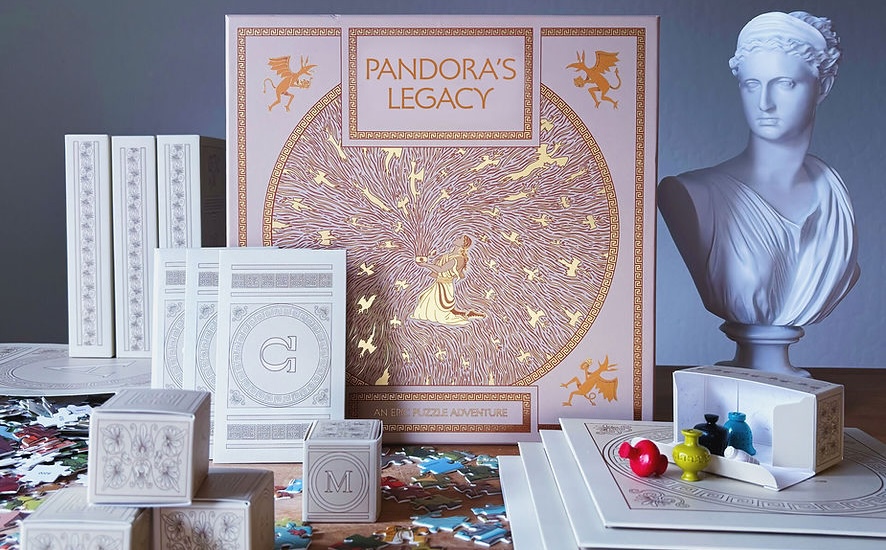
Pandora’s Legacy
Review
Game Description
“Playing as Pandora, with the help (and hindrance) of your favorite Olympians, your mission is to corral the chaos you created when you opened the box. From TED Games, PANDORA’S LEGACY is an unforgettable experience that combines elements of jigsaw puzzles, escape rooms, puzzle hunts, and legacy board games into immersive, cooperative gameplay. Assemble pieces. Decode riddles. Uncover artifacts. Save the realm.”
Personal Experience
Pandora’s Legacy intrigued me from the moment it was announced. A collaboration between puzzle game powerhouse Postcurious and TED (of TED Talks fame), Pandora’s Legacy seems poised to try and expand the market by combining the best puzzle game developer in the industry with a brand that is more of a household name.
I recognize there is a certain irony in talking about how I’m not a jigsaw puzzle aficionado in my last review for Mother of Frankenstein and then following that up by reviewing a game that is even more focused on jigsaw puzzles. While I haven’t been converted to a jigsaw aficionado, I had a much better time assembling this 1000+ piece table monster than I did with Mother of Frankenstein. I’ll delve more into the reasons below, but suffice it to say, this is a very good game. I set it up on my dining room table and played it in small sessions over the course of a few weeks in March. The game was big enough, that I had to extend the table so we could have a place to eat.
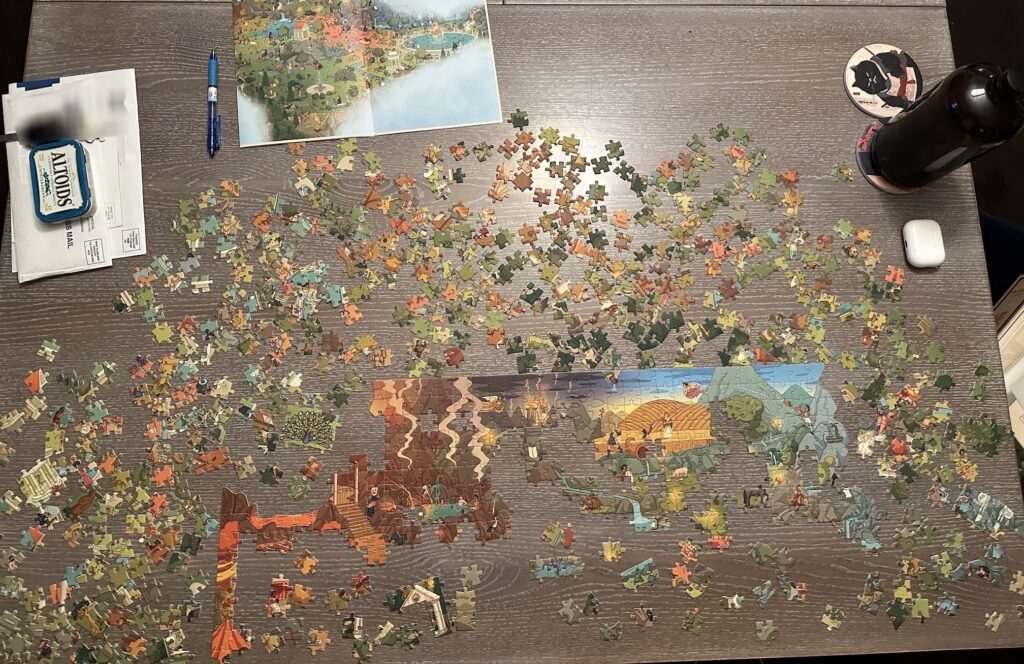
I kept track of all those small sessions and it added up to a whopping 17 hours of play time—quite the epic experience!
Narrative
Like all Postcurious works, the narrative in Pandora’s Legacy shines bright. The game is based off of the Greek myth of Pandora, casting you in the titular role as you deal with the consequences of unsealing evils into the world. Despite its origins in antiquity the writing in the game is modern and fresh, with light-hearted, humorous dialogue.
The narrative is reinforced by the colorful and fun artwork featured on the jigsaw puzzle, which (perhaps intentionally) reminded me a lot the Where’s Waldo books I played through as a kid. There’s a remarkable amount of detail in the illustration, with special care taken to make sure that details in the artwork aren’t obscured by the die cuts. The joy in discovering the little details in the artwork and the many, many allusions to Greek myths (many I caught and many more I’m sure I didn’t!) made assembling the puzzle more fun than I expected it to be.
Puzzle Play
Let’s start with the centerpiece of this game: the jigsaw puzzle. The game does many thoughtful things to make the assembling experience as delightful as it can be. The back of almost every piece is numbered and the orientation of the numbering is consistent, allowing you to figure out which way is up on a particular piece. The quality of the cardboard used is top-notch, helping the pieces snap together in a satisfying manner. The game comes with a printed illustration of the main portion of the puzzle that can be passed around and looked at. Part of the puzzle experience involves finding and removing certain pieces, the game includes a physical tool that makes removing the pieces a cinch.
The only minor nit I had (and I’m really splitting hairs here) was that the four corners of the map (which have to be unlocked later in the game) only have one connection point to the main part of the map. So when they were added, it was easy to knock them loose. Another connection point or two could have easily fixed the problem.
Outside of the jigsaw puzzle, the rest of the game was played through a website. It’s a pretty solid system and keeps track of your progress as you play. Most of the puzzles require you to find pieces on the map and remove them, then enter the numerical code on the back into the website for more information. The designers were thorough enough to even account for expected wrong answers, gently nudging the player back towards the proper solution. The hint system also is integrated well into this, providing progressively hintier hints for the puzzle you’re working on at that moment.
I thought the puzzles were mostly well written, with a really nice difficulty curve that ramps up throughout the game. There were a couple of puzzles that I thought could have used a slight bit of additional playtesting, but nothing game-breaking. (The ones that required real-world knowledge, especially.) One or two of the more difficult puzzles verged on the border of esoteric, but I think having more than one player playing would help mitigate that.
Recommendation
Pandora’s Legacy is another great Postcurious game that innovates and elevates the genre. I highly recommend it to all puzzle gamers, especially those that have a penchant for jigsaws. I also think it would be a great choice for a parent to play with a teenage kid who’s learning about Greek mythology in school.
Details
Type of Game: At Home Puzzle Game
Date Played: March 2026
Price: $80
Company: Postcurious and TED-Ed
Website: https://getpostcurious.com/
Team Size: 1
Colorblind-friendly: Yes
